

Turn research prompts into quantitative code and traceable experiments.





FlowLLM-AI builds AxonX, an agent-native harness for quantitative research. Combine your research prompt with the AxonX Skill and let an external or built-in Agent develop a research plugin, run experiments, inspect results, and iterate on factors, models, and portfolio strategies.
You define the research question; the Agent implements it; AxonX manages execution and evidence.
| Your goal | First step |
|---|---|
| Explore without installing anything | Try Studio Playground, using simulated data and execution. |
| Run your first local experiment | Follow the quick start. The built-in demo needs no market-data or model credentials. |
| Develop or improve quantitative code with an Agent | Load the AxonX Skill, describe your research objective, and follow the Agent integration guide. |
| Build a new research plugin | Read the development guide for Task contracts and compatible artifacts. |
Local execution supports Python 3.12+ on macOS and Linux. Research plugins are installed separately from source in the selected execution service's environment; see plugin management.
- Develop quantitative code. Use an external coding Agent or Studio's built-in Agent to create or improve plugins.
- Execute experiments. Discover typed Task inputs and outputs, submit work, follow progress and logs, or cancel Runs.
- Inspect and iterate. Compare configurations, metrics, models, predictions, and backtests, with Task/Run IDs and upstream dependencies.
CLI, HTTP, MCP, and AxonX Studio share Jobs for submitting and querying Tasks. A selected local or remote execution service runs the plugin code and keeps the research evidence in its workspace.
The current reference workflow adapts Microsoft Qlib's Alpha158 baseline into ETL → Train → Predict → Backtest, with factor analysis branching from ETL. Plugins reuse compatible implementations and artifacts:
| Plugin | What you can explore |
|---|---|
| qlib_a158 | 158 price/volume features, LightGBM training, factor analysis, and TopN backtests. |
| qlib_factor | 13 optional market-moment, neutral-momentum, and risk features; training defaults to the 158 baseline features. |
| qlib_strategy | Minimum holding periods, rank retention, and replacement limits, reusing predictions without retraining. |
Agents can improve these plugins or implement other research methods through the same Harness contracts.
Open the browser Playground to explore Tasks and research charts with simulated data and execution. No local installation is needed.
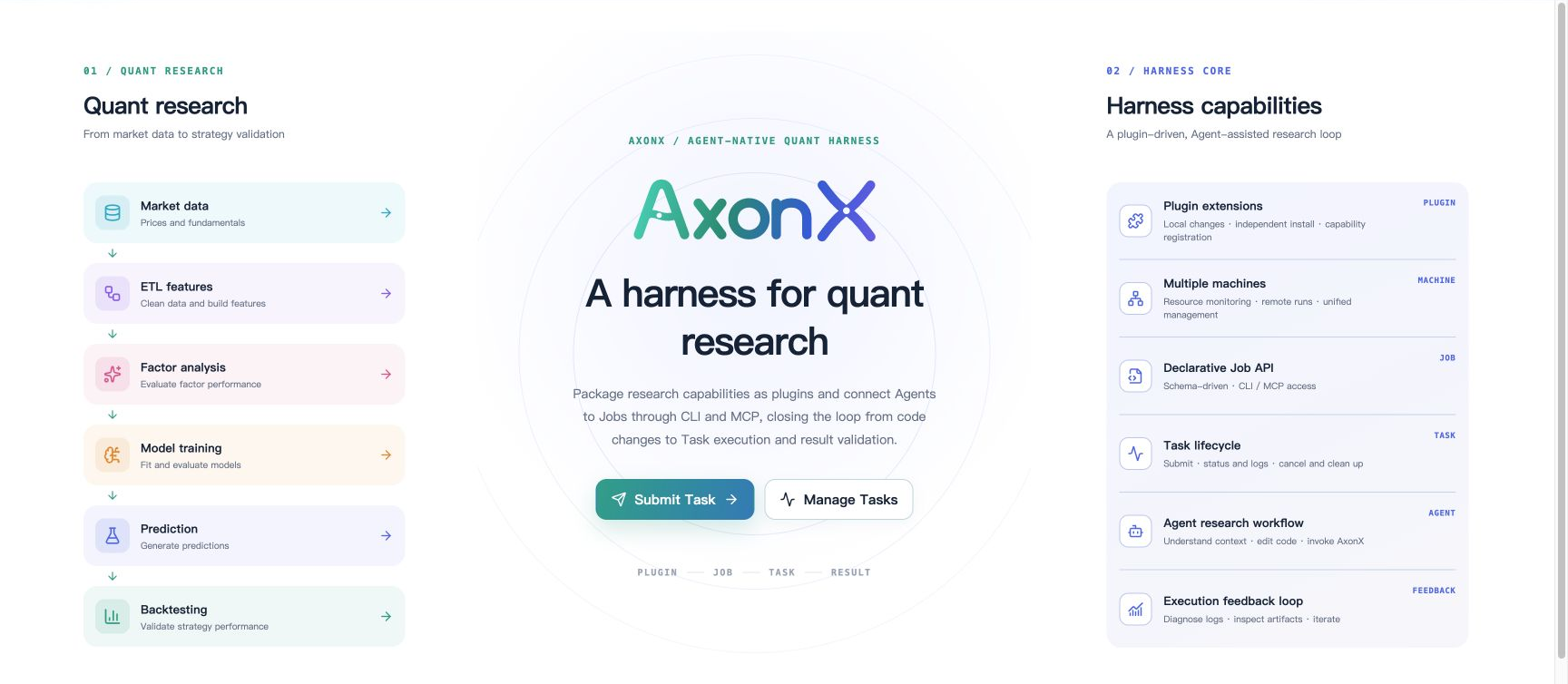
For real experiments, deploy AxonX and install your plugins. Studio lets you work with the built-in Agent, inspect Task lineage and research artifacts, and select a local or remote execution service. Market data and model services may require API credentials.
The current Alpha158 case compares the adapted baseline, a model with two added risk factors, and a rank-retention strategy that reuses the factor-model predictions. The 2026-10-10 rerun reports:
| Configuration | Top20 net annualized return | Net Sharpe | Daily two-sided turnover |
|---|---|---|---|
| Alpha158 baseline | 7.67% | 0.3619 | 198.83% |
| Risk-factor model | 9.03% | 0.4052 | 199.35% |
| Rank-retention strategy | 32.37% | 1.1575 | 40.01% |
Training covers [20150101,20230101); evaluation covers 20230103–20261008 (909 market dates), with buy/sell fees
of 0.05% / 0.15%. These are adapted AxonX experiments. They have no independent confirmation window, the model
settings do not isolate the added factors, and all three backtests report incomplete_market_data. Fills use
same-close quote proxies and 2026 is a partial year.
See the full settings, evidence limits, reproduction commands, and Task provenance.
- Latest published release: AxonX v0.1.2, October 10, 2026.
- Current main branch: Agent development-guide loading, improved streamed tool arguments and Studio Task views, plus authenticated service self-update Jobs and restart controls. See the update guide for availability and recovery behavior.
- Questions, ideas, and research examples: join GitHub Discussions. English and Chinese are welcome.
- Bugs and concrete feature requests: open an AxonX issue.
- Contribute: improve documentation, develop research plugins, or fix bugs. Start with the contribution guide.
- Follow development: star AxonX and watch its repository for updates.
FlowLLM provides configurable LLM application workflows. Finance-MCP uses FlowLLM to serve financial search, crawling, and data tools for MCP clients. Explore them when your work needs those capabilities.