
A Model Context Protocol (MCP) server that enables AI assistants like Claude to work directly inside SAP BW/4HANA or SAP BW 7.5 on HANA systems — reading, creating and modifying BW modeling objects via the same internal SAP APIs that Eclipse BWMT and the BW/4HANA Cockpit use: the BW Modeling REST API (/sap/bw/modeling/) for objects, queries and live data, the ADT API (/sap/bc/adt/) for the ABAP and AMDP routines BW generates, the BW/4HANA manage API for the request monitor and runtime, and the Push API (/sap/bw4/) for data loads.
This is not a simulation. Every tool call connects to a live BW system — write operations produce real changes.

Besides stdio, the server can run as an HTTP service on SAP BTP Cloud Foundry with XSUAA
OAuth in front and a BTP destination behind — either a shared technical user
(BasicAuthentication) or principal propagation, where each caller reaches BW as
themselves and BW applies their own authorizations.
Three role collections decide what a user is offered: BW MCP Reader (everything that only reads), BW MCP Analyst (a small reporting client — run queries and understand what they return) and BW MCP Developer (everything, including changes).
stdio is unchanged — npm start behaves exactly as before. Setup:
docs/CENTRAL-HOSTING-SETUP.md (step-by-step) and
docs/CLOUD-FOUNDRY.md (reference).
| Scenario | stdio only | Hosted on BTP |
|---|---|---|
| One analyst, one BW system | runs on the analyst's machine | server-side, the analyst logs in with their own identity |
| Several analysts, one server | not possible, no central auth | all log in via BTP, each caller's identity reaches BW |
| Tool permissions | none — whoever runs it can call every tool | granted per role, independent of BW authorizations: a BW developer can be read-only in the MCP, or the querying tools can be withheld from someone who may otherwise view data |
| BW authorizations | enforced through the user's own credentials | unchanged, still fully enforced — with principal propagation each caller acts as themselves, never as a shared identity |
| Audit trail | limited | XSUAA logs every login; with principal propagation the BW session log shows the real user |
A new tool stays unavailable to read-only callers until it is explicitly classified as a
read, so the surface never widens by accident; write implies read, never the reverse.
The three role collections are a starting point and can be split further in xs-security.json.
Principal propagation additionally needs a certificate rule and ICM trust on the BW side.
| System | Support |
|---|---|
| SAP BW/4HANA (all versions) | ✅ Full support |
| SAP BW Bridge (SAP BTP ABAP stack) | ✅ Via cookie authentication (BW_COOKIE_FILE) |
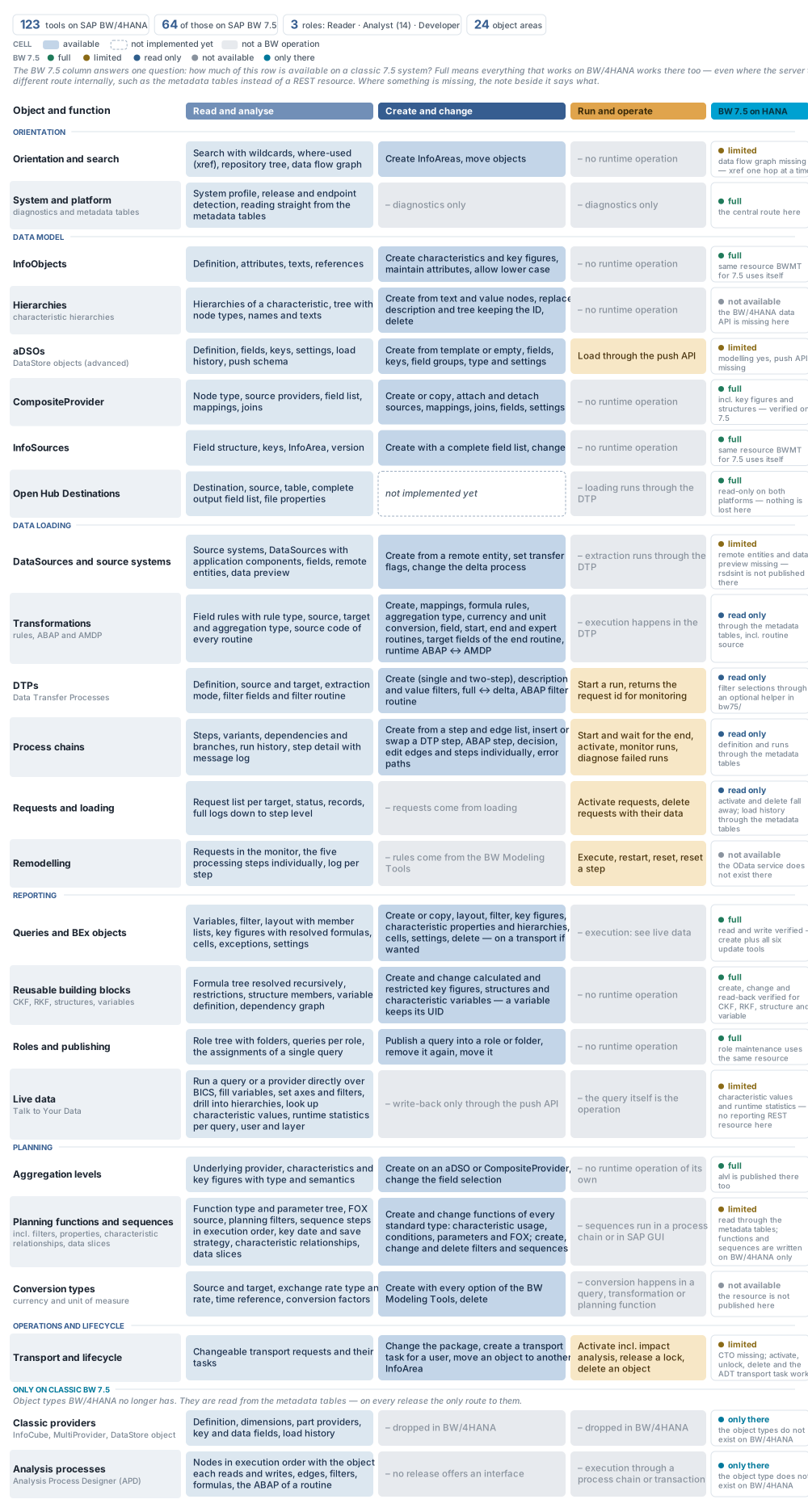
| SAP BW on HANA (7.5) | ✅ Modelling reads after a small ABAP enhancement, and modelling writes for every object type except the InfoObject — aDSOs, InfoAreas, InfoSources, CompositeProviders, queries and their reusable components, aggregation levels. The tool surface adjusts to what the system publishes, and the objects without a REST resource — including planning, chain runs and the APD — are read from their metadata tables. bw_system_profile states per write tool what was verified there. See BW 7.5 Support |
On SAP BW 7.5 the REST framework looks up the Accept header case-sensitively while the kernel delivers header names in lower case, so almost every call fails with HTTP 406. A ~20-line post-exit enhancement (no modification) resolves this and makes all REST endpoints that exist on 7.5 reachable. Objects for which BW 7.5 ships no REST resource at all — transformations, DTPs, process chains and their runs, classic DSOs, InfoCubes, the planning objects and the Analysis Process Designer — are readable through bw_read_metadata_tables, which goes to their metadata tables instead, but they cannot be written; Eclipse opens the embedded SAP GUI for those as well. Details, ABAP code and setup steps: bw75/BW75-SUPPORT.md.
A two-part blog series about this project (both available in German and English):
-
Agentic AI meets SAP BW — the full story behind this project: why I built it, what's inside, what happens when Claude walks through a complete BW data lineage on its own. https://www.nextlytics.com/blog/agentic-ai-meets-sap-bw
-
Agentic AI in practice: MCP server for SAP BW/4HANA — how the server is operated company-wide on SAP BTP Cloud Foundry with role-based access and per-user identity, plus two real customer projects. https://www.nextlytics.com/blog/agentic-ai-in-practice-mcp-server-for-sap-bw/4hana
🔒 Security fix for hosted servers. On SAP BTP, a client that registered itself could
complete the sign-in of a user who was already logged in through SSO without that user's
approval (GHSA-6935-r3wv-f646).
Every new sign-in now shows an approval page with the client's name and return address.
Local use over stdio is not affected. If you host the server, update the XSUAA instance
as well as the app — xs-security.json now holds only the server's exact callback; see
docs/CLOUD-FOUNDRY.md. Thanks to @marianfoo (#49).
📐 Query design, continued
- New
bw_update_query_exceptions— creates, changes and removes the exceptions that colour data cells: thresholds per alert level, fixed or by formula variable, the members they are evaluated on and the cells that show the alert;for_each_membercreates one per key figure - The characteristic structure of a query can now be created, and holds formulas — a comparison of two selections gets its delta and percentage columns in one call
bw_update_composite_providerswitches navigation attributes of a field on or off, and names the union parts that cannot deliver them before activation refuses them- Fixed: saving a characteristic with more than one attribute, source fields of providers with field groups, and auto-mapping of reserved fields; dependency advisories cleared
The workbooks your planners and controllers actually work in are now within reach of the agent: find them, see what they depend on, take one out of BW, change it, and put it back into the role menu where users open it.
📊 Analysis for Office workbooks stored in BW
- New
bw_list_afo_workbooks— every workbook stored in BW with its where-used list: data sources, planning functions and sequences, BPC models, role menus, last change.used_objectanswers the question to ask before touching a query or planning function: which workbooks break if I change this? - New
bw_get_afo_workbook— fetches a workbook exactly as Analysis for Office opens it, without taking the edit lock, so nobody working in it is disturbed. BW checks the caller's authorization, so under principal propagation everyone gets only what they may open - New
bw_save_afo_workbook— saves a workbook back the way Analysis for Office does and adds it to a role menu; the where-used list is built from the file itself, so a planning function added to the workbook is recorded in BW. Nothing is overwritten withoutoverwrite: true
Together they close the loop: take a workbook out of BW, change it, and save it back to the role menu your users open it from.
🌳 Hierarchy nodes in query structures
- Structure members can be restricted to hierarchy nodes or a hierarchy node variable, in the key figure structure and in the characteristic structure
switch_hierarchymoves every node restriction of a structure to another hierarchy in one save, with renamed nodes mapped; unknown hierarchies and nodes are refused before BW stores them silently (#50)
🧮 Agentic Planning, continued
- New
bw_set_adso_planning_mode— switches a planning aDSO between planning and loading, as the toggle in the BW/4HANA Cockpit does, and checks that the switch took effect - New
bw_add_process_chain_plswitch— puts the switch to load mode and back around the load of a planning aDSO in a process chain, in one call and without the chain editor - New
bw_delete_adso_data_selective— selective deletion by conditions on characteristics; simulates first and counts what would go
🛠️ Fixes and improvements
- SAP sessions are ended after every tool call instead of piling up in SM04 until users are locked out (#48); connections to the backend are reused, so reads answer faster; an InfoArea can be moved back to the top level
Thanks to @alxy for #50, and to @army113 and @MWKAnalytics for the analysis behind #48.
An agent can now build a BW planning model end to end — aggregation level, planning functions, filters and the planning sequence that ties them together — and start the process chain that runs it.
🧮 Agentic Planning Modelling
- New
bw_create_planning_function/bw_update_planning_function— every standard function type, each one created and read back: copy, delete, repost, distribution by key and by reference data, set values, revaluation, formula (FOX), characteristic relationships, currency and unit translation, forecasting - Characteristic usage, conditions, parameters (constant or variable), key figure and data selections in the same call; what the function type may not change is refused before saving
- New
bw_create_planning_filter/bw_update_planning_filterandbw_create_planning_sequence/bw_update_planning_sequence;bw_deleteremoves both - Deeper reads:
bw_get_planning_filter, characteristic relationships and data slices inbw_get_planning_properties, the function type with all its parameters and the block characteristics inbw_get_planning_function
💱 Currency translation and unit conversion types
- New
bw_get_conversion_type/bw_create_conversion_type— currency translation and unit conversion types with every option of the BW Modeling Tools: source and target fixed, from the record or from a variable; exchange rate type, rate and time reference; unit factors from T006, an InfoObject or SI units;bw_deleteremoves them - Not a planning-only object: a translation type created here serves queries, transformation rules and planning functions alike — until now none could be created outside the modeling tools
- New
bw_start_process_chain— starts a chain now, in the background; withwait_secondsit waits for the result, and the log ID leads straight intobw_get_process_chain_run_detail
🌳 Hierarchies
- New
bw_get_hierarchy,bw_create_hierarchy,bw_update_hierarchy,bw_delete_hierarchy— text and value nodes; replacing the tree keeps the hierarchy ID, so queries that use it keep working
🔁 Transformations on a transport
bw_create_transformationtakes a transport request and can activate in the same call (#32)
📈 Query statistics without SAP GUI
- New
bw_query_statistics— executions, users, runtime percentiles and the slowest runs broken down by layer, read from the BW statistics;bw_query_datawithwith_statisticsmeasures its own call (#44)
🔤 Formula and text variables
bw_create_variablecreates formula variables (dimension, default value, unit or currency) and text variables (replacement path or exit); text variables in descriptions are bound so they resolve at runtime instead of showing&NAME&(#47)
🔍 Query data that says what happened
bw_query_datafilters hierarchy nodes, keeps interval bounds, says whether more rows follow and lists what BW did not apply (#45);bw_get_queryshows display hierarchies
🛠️ Fixes
- A short dump no longer leaves the server unable to lock; amount key figures activate; creates work behind a BTP destination and release their lock when they fail; master system read from the system (#34); rate limit per client on Cloud Foundry (#35); dependency advisories cleared (#40)
Thanks to @MWKAnalytics and @oliverluette for the analyses behind #44, #45 and #47.
Earlier releases — the "What's New" notes for v1.7.0 and older are archived in WHATS_NEW.md; the full structured history is in CHANGELOG.md.
An overview by area. Every tool in detail — parameters, behaviour, and the sequences it belongs in — is in the Tools Reference (130 tools).
bw-modeling-mcp works best alongside an ADT MCP server such as vibing-steampunk or ARC-1. The two do not overlap as much as it may look.
This server owns the BW object and, with it, the body of the ABAP that BW generated for that object: the class behind a transformation routine, the program behind a DTP filter routine. Write those through bw_set_transformation_routine, bw_set_transformation_expert_routine and bw_set_dtp_filter_routine rather than through ADT — they do not only replace the source, they save the transformation master back afterwards, which is what re-registers the code in the transportable metadata. A class-only edit survives until the next regeneration or transport and is then gone.
The ADT MCP server covers ABAP as a subject in its own right: your own reports, classes, function modules and DDIC tables, repository search and navigation, arbitrary table reads, debugging, ATC, unit tests, dumps and transports. Together they cover the full cycle from BW object to ABAP logic.
- SAP BW/4HANA system with the internal SAP APIs enabled (SAP BW 7.5 works for modeling reads and most modelling writes once the enhancement in bw75/BW75-SUPPORT.md is in place)
- Node.js 22 or later
- An MCP-compatible AI client (Claude Desktop, Claude Code, etc.)
Two ways to run. Locally as a stdio server (one user, one machine — the steps below), or centrally hosted on SAP BTP Cloud Foundry behind XSUAA OAuth for a whole team → see docs/CENTRAL-HOSTING-SETUP.md. The installation and configuration below cover local stdio use; upgrading an existing local setup is non-breaking.
# Option 1: Install via npm (recommended)
npm install -g bw-modeling-mcp

# Option 2: Clone and build
git clone https://github.com/dnic-dev/bw-modeling-mcp.git
cd bw-modeling-mcp
npm install
npm run buildFor local (stdio) use, the server is configured via environment variables. For central BTP hosting, connection and credentials come from the BTP destination and service bindings instead — see docs/CENTRAL-HOSTING-SETUP.md.
| Variable | Description | Required |
|---|---|---|
BW_URL |
BW system URL (e.g. https://myhost:50001) |
yes |
BW_USER |
SAP user name | yes (or BW_COOKIE_FILE) |
BW_PASSWORD |
SAP password | yes (or BW_COOKIE_FILE) |
BW_CLIENT |
SAP client (e.g. 001) |
yes |
BW_LANGUAGE |
Language for object texts (e.g. EN, DE). Default: DE |
no |
BW_COOKIE_FILE |
Path to a browser-exported cookie file for SAML-/OAuth-fronted systems (e.g. BW Bridge). Netscape or name=value format. When set, BW_USER / BW_PASSWORD are optional. |
no |
BW_MCP_SERVER_NAME |
Server name advertised in the MCP initialize handshake. Default: bw-modeling-mcp. Give each instance a unique name when running several against different BW systems. |
no |
BW_MCP_SYSTEM_LABEL |
Free-text label of the connected BW system (e.g. AP4 (BW production, read-only)), put at the top of the MCP server instructions. Lets a model tell look-alike instances apart even in clients that show an opaque connector id instead of the server name. |
no |
BW_PLATFORM |
auto (default), classic or bw4. The server detects whether it is talking to BW/4HANA or a classic release and offers only the tools that release can answer. classic forces that verdict when detection cannot run, bw4 switches the filter off. See bw75/BW75-SUPPORT.md. |
no |
BW_SESSION_CLOSE |
on (default) or off. The server ends the SAP sessions of a tool call once it is answered, and all remaining ones when it stops. Set off only behind a proxy that holds the SAP session itself. |
no |
Cookie authentication (BW Bridge / SAP BTP): For BW systems that sit behind a SAML or OAuth login (such as BW Bridge on the SAP BTP ABAP stack), Basic Auth is not available. Export the authenticated session cookies from your browser into a file and point BW_COOKIE_FILE at it. The login/session approach is analogous to vibing-steampunk and ARC-1. When the session expires, refresh the cookie file and restart the server.
Add to claude_desktop_config.json:
{
  "mcpServers": {
    "bw-modeling-mcp": {
      "command": "node",
      "args": ["/path/to/bw-modeling-mcp/dist/stdio.js"],
      "env": {
        "BW_URL": "https://your-bw-host:50001",
        "BW_USER": "YOUR_USER",
        "BW_PASSWORD": "YOUR_PASSWORD",
        "BW_CLIENT": "001",
        "BW_LANGUAGE": "EN"
      }
    }
  }
}Add .mcp.json to your project root:
{
  "mcpServers": {
    "bw-modeling-mcp": {
      "command": "node",
      "args": ["/path/to/bw-modeling-mcp/dist/stdio.js"],
      "env": {
        "BW_URL": "https://your-bw-host:50001",
        "BW_USER": "YOUR_USER",
        "BW_PASSWORD": "YOUR_PASSWORD",
        "BW_CLIENT": "001",
        "BW_LANGUAGE": "EN"
      }
    }
  }
}The server talks to four SAP APIs, and only one of them needs a protocol worth describing.
The BW Modeling REST API (/sap/bw/modeling/) is a full-document API: there is no way to
change one attribute of an object. Every write therefore runs the same six steps.
- Lock — acquires an exclusive lock and returns a
lockHandle - Read — fetches the current complete XML of the object
- Modify — applies the change to that XML
- PUT — sends the whole document back, never a fragment
- Activate — promotes the inactive version to the active one
- Unlock — releases the lock
Two consequences are worth knowing. Saving and activating are separate: a document the server accepts can still fail to activate, so a successful write proves less than it appears to. And because the whole document travels, a read that came from a stale session buffer will silently write old values back — the tools read fresh for exactly this reason.
The other three need none of it. The ADT API (/sap/bc/adt/) is used narrowly and always for
an object BW generated itself: the body of a transformation routine (its generated class), the
body of a DTP filter routine (its generated program), the DataPreview service behind
bw_read_metadata_tables, plus transport checks and activation runs. Everything else ABAP —
writing your own reports, classes or DDIC tables, searching the repository, reading arbitrary
tables, debugging — is the job of an ABAP ADT MCP server alongside this one, see
Combining with an ADT MCP Server. The BW/4HANA manage API (/sap/bc/http/sap/bw4/) answers the request
monitor, the remodeling monitor and runtime operations. The Push API (/sap/bw4/v1/push/)
takes a JSON record array straight into a write-interface aDSO.
Session cookies and CSRF tokens are handled for all four.
See ARCHITECTURE.md for the full technical architecture and the complete endpoint reference.
- Focused mode — an optional, reduced tool surface: a handful of broad tools in place of the full set, for clients and models that work better with fewer tools to choose from.
Issues and feature requests are welcome — please use the Issue templates.
If you have access to a BW/4HANA system and want to help expand coverage, I am happy to hear from you. The best way to contribute is to try it out and report what works, what doesn't, and what's missing.
MIT