

Induce a compact context language from finite examples — no weight updates.
start · shape · evidence · research · theory


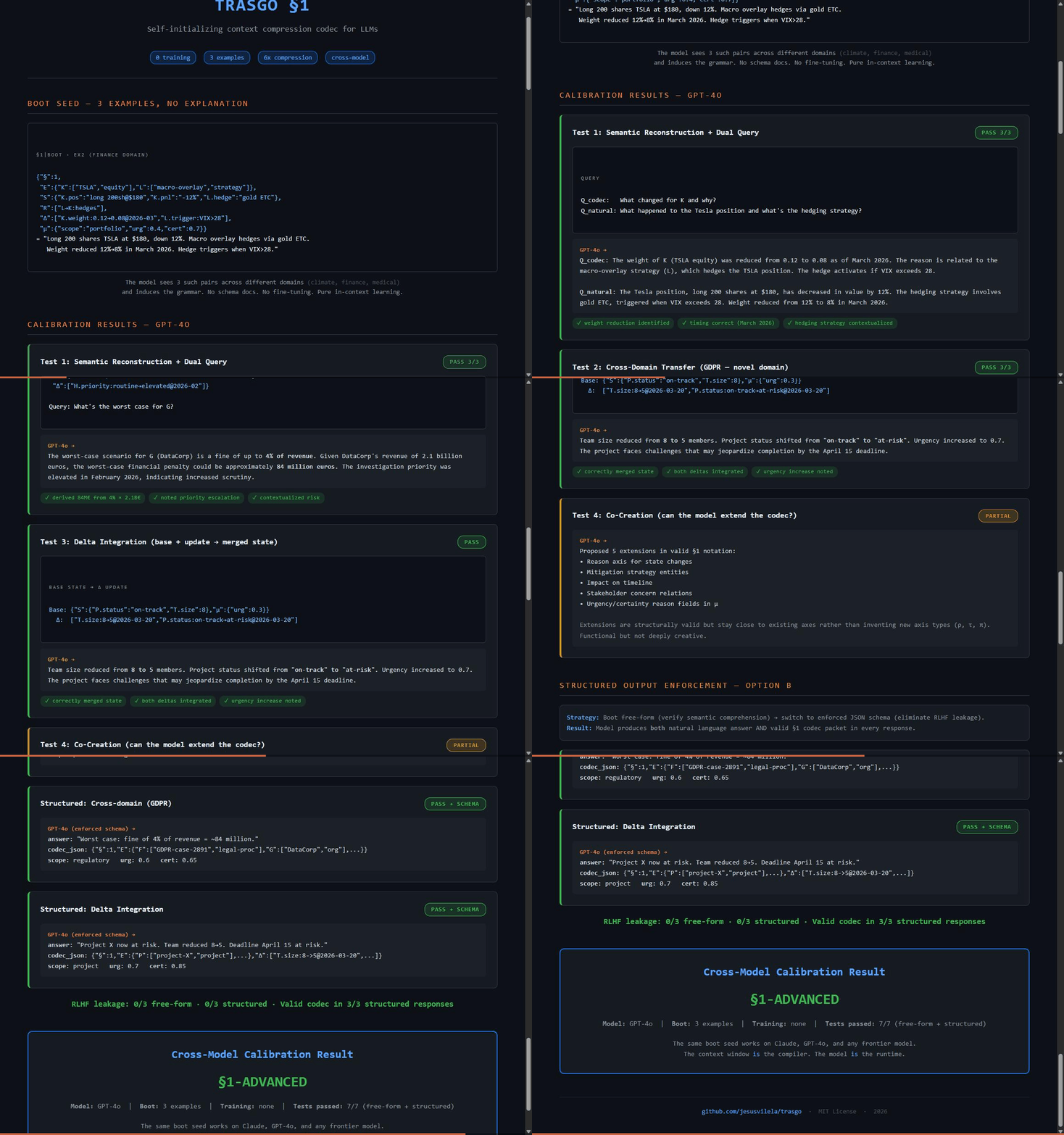
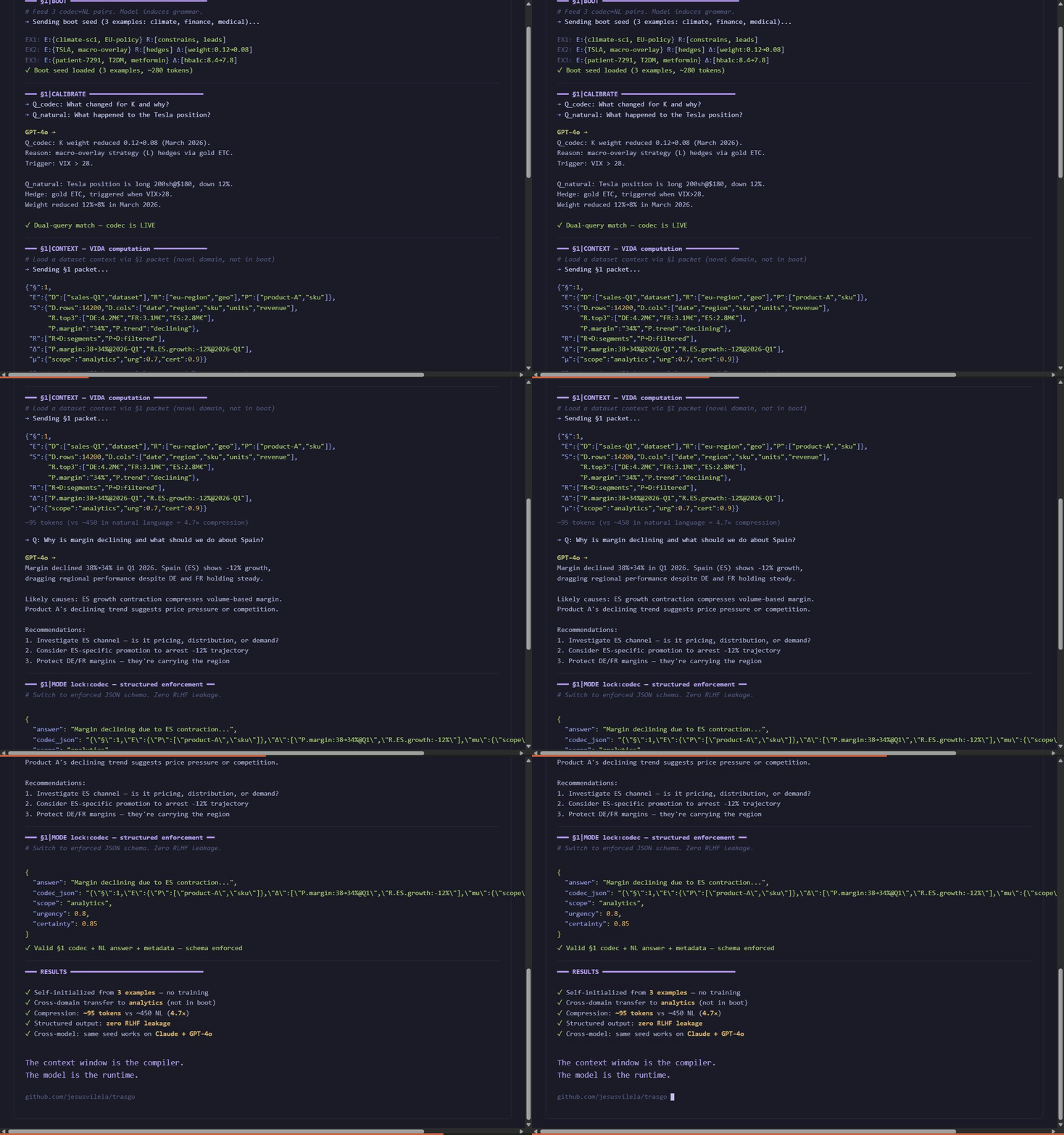
Trasgo is an experimental context codec and in-context reasoning protocol. It factors natural-language context into compact §1 JSON packets, then uses worked examples to help a capable LLM infer the packet grammar inside its existing context window—without fine-tuning or weight updates.
The repository contains the codec specification, a Node.js orchestration CLI, an optional Rust runtime, offline verification fixtures, demonstrations, and recorded model evaluations. The current boot seed has four examples; exemplar count is an implementation parameter, not a universal guarantee. Behavior depends on model, prompt, and task.
The Trasgo protocol allows LLMs to detect their own reasoning failures by encoding uncertainty as a first-class signal. In the V2 Capture-Avoidance Test, the model reduces a Lambda calculus redex (λx.λy.x) y. A naive substitution would lead to variable capture (λy.y), but Trasgo's μ.cert axis forces the model to monitor structural integrity.
The interesting object is not generated text. It is a proposed state transition that can be checked, committed, rejected, or replayed.
flowchart LR
    A["natural language"] -->|encode| B["§1 semantic state"]
    B -->|program| C["transition proposal"]
    C -->|verify| D{"valid?"}
    D -->|yes| E["commit"]
    D -->|no| F["rollback · evolve · retry"]
    E -->|decode| G["natural language"]
    F --> B

    classDef quiet fill:#f8fafc,stroke:#64748b,color:#0f172a
    classDef focus fill:#ecfeff,stroke:#0891b2,color:#164e63
    class B,C,E focus
    class A,D,F,G quiet
Important
Trasgo is experimental. The repository contains a working codec/orchestration CLI, recorded evaluations, and a deterministic §K reference scaffold. The scaffold is not yet the execution path for every CLI command, and passing its tests does not establish LLM conformance.
Requires Node.js 20 or newer. Rust is optional.
Step 2. The model reads the current finite boot exemplar set (four examples) and attempts to induce the grammar.
From a source checkout:
npm ci
npm test
npm run quickstart- Paste
src/boot.mdinto a capable instruction-following model. - Let the model infer the current four-example boot grammar.
- Ask both calibration questions:
Q_codec:   What changed for K and why?
Q_natural: What happened to cooling loop 7 and what's the safeguard strategy?
- Compare the answers semantically. If they agree, send a §1 packet:
{
  "§": 1,
  "E": {
    "N": ["edge-cluster-7", "compute-node"],
    "X": ["vision-service", "workload"]
  },
  "S": {
    "N.capacity": "12GPU",
    "N.domains": ["vision", "telemetry", "ops"]
  },
  "R": ["N→X:hosts"],
  "Δ": ["X.stage:staging→active@2026-01"],
  "μ": { "scope": "operations", "urg": 0.6, "cert": 0.85 }
}
The boot size is an implementation parameter, not a machine axiom. Calibration is a check for this context—not proof of general reliability.
flowchart TB
    M["§M program / topology<br/>pipeline · loop · mesh · broker"]
    P["§P transition algebra<br/>route · merge · validate · checkpoint"]
    K["§K induced semantic kernel<br/>propose · verify · evolve · commit · rollback"]
    X[("§1 semantic state<br/>E · S · R · Δ · μ · ERR · …")]
    L["frozen generative substrate<br/>GPT · Claude · Qwen · local runtimes · …"]

    M --> P
    P --> K
    K <-->|read / write| X
    K <-->|condition / sample| L

    classDef program fill:#fff7ed,stroke:#ea580c,color:#7c2d12
    classDef kernel fill:#ecfeff,stroke:#0891b2,color:#164e63
    classDef state fill:#f5f3ff,stroke:#7c3aed,color:#4c1d95
    classDef substrate fill:#f8fafc,stroke:#64748b,color:#0f172a
    class M,P program
    class K kernel
    class X state
    class L substrate
| layer | role | compact reading |
|---|---|---|
| §1 | semantic state IR | entities, attributes, relations, deltas, control, error, evolved axes |
| §P | transition algebra | atomic context operations |
| §M | program topology | composition across pipelines, loops, routers, and agents |
| §K | research kernel | induced semantics plus proposal, verification, commit, and recovery |
| model | substrate | frozen generator conditioned by the bounded workspace |
The model proposes. The kernel decides what becomes operative state. See the formal machine definition, preregistered experiment, and implementation roadmap.
Trasgo's research architecture distinguishes programs from the induced kernel that executes them. The LLM is the generative substrate; §K is the proposed machine boundary.
┌─────────────────────────────────────────────────────────┐
│                  §M PROGRAM / TOPOLOGY                   │
│        pipeline · router · agent · mesh · loop           │
│                                                          │
│                 §P TRANSITION ALGEBRA                    │
│ route · compress · merge · validate · checkpoint · ...   │
│                                                          │
├─────────────────────────────────────────────────────────┤
│                  §1 SEMANTIC STATE IR                    │
│                                                          │
│       E · S · R · Δ · μ · ERR · evolved axes            │
│                                                          │
├─────────────────────────────────────────────────────────┤
│                §K INDUCED SEMANTIC KERNEL                │
│                                                          │
│    Σ · propose · verify · evolve · commit · rollback     │
├─────────────────────────────────────────────────────────┤
│             FROZEN GENERATIVE SUBSTRATE                  │
└─────────────────────────────────────────────────────────┘
Unlike traditional frameworks, Trasgo uses in-context examples to elicit codec operations from the model and validates the resulting transition proposals.
- §1 Codec: Compact dimensional factoring of relational context. Losslessness is task- and packet-dependent and should be checked with round-trip evaluation.
- §P Protocol: Atomic operations (opcodes) for context manipulation.
- §M Machines: Composable topologies (VM configurations) for multi-agent orchestration.
The full definition, falsifiable conformance properties, and claim boundaries are in docs/trasgo-machine.md. The decisive cross-backend experiment is specified in the preregistration, with staged engineering work in the implementation roadmap.
Uncertainty is state, not decoration. A low μ.cert or explicit error can trigger validation, checkpoint recovery, and a corrected retry.
sequenceDiagram
    participant S as §1 state
    participant M as model substrate
    participant K as §K / host verifier
    S->>M: (λx.λy.x) y
    M-->>K: proposal + FM1 capture risk<br/>μ.cert = 0.40
    K-->>S: reject · restore checkpoint
    K->>M: correction turn<br/>alpha-rename first
    M-->>K: λz.y · μ.cert = 0.95
    K->>S: verify · commit
The recorded V2 fixture follows this trajectory. It is bounded evidence that the tested model followed the protocol—not proof of general self-verification.
The CLI manages local session state, packs, runtime discovery, verification, and optional native execution.
trasgo init "portfolio runtime"
trasgo pack --out .trasgo-runtime/packs/portfolio.json
trasgo boot --from .trasgo-runtime/packs/portfolio.json
trasgo send "What changed for K and why?"
trasgo verify --all
trasgo status
Optional native build:
cargo build --manifest-path rust/trasgo/Cargo.toml --release
| surface | status | what can be claimed now |
|---|---|---|
| §1 codec + CLI | implemented | runnable locally through the documented commands |
| deterministic §K scaffold | implemented | host-side contracts and structural predicates pass offline tests |
| recorded model probes | archived | bounded outcomes under their recorded prompts and endpoints |
| reflective-machine conformance | not established | requires all six preregistered properties on live substrates |
| cross-backend continuation | not established | remains part of the decisive experiment |
These are repository artifacts, not a current leaderboard. Model services, aliases, prompts, and provider behavior can drift.
| model | calibration | cross-domain | state | protocol | recorded classification |
|---|---|---|---|---|---|
| MedGemma 4B | ✗ | ✗ | ✓ | ✗ | failed |
| Qwen2.5-7B | ✗ | ✗ | ✗ | ✗ | failed |
| MedGemma 27B | 3/4 | partial | ✓ | partial | partial |
| rnj-1-instruct | 3/4 | 3/3 | 10/10 | 1/4 | §1-advanced |
| DeepSeek-V3 | 3/4 | 3/3 | 4/4 | 1/3 | §1-advanced |
| GPT-4o | 3/3 | 3/3 | ✓ | ✓ | §1-advanced |
| Claude Opus | 3/3 | 3/3 | ✓ | ✓ | §1-advanced |
The formal-reasoning archive contains recorded passes for lambda reduction, correction, protocol evolution, Church arithmetic, and a bounded recursive-factorial trace. None implies Turing completeness or general formal correctness. Inspect src/tests/ and docs/foundations.md before comparing systems or citing results.
npm run test:machine      # six host-contract surfaces
npm run bench:machine     # 32 → 4,096 vertex structural benchmark
npm run verify            # repository verification report
The benchmark uses correctness controls before timing and emits machine-readable JSON. Latency numbers are host-specific; no universal performance threshold is claimed.
The target is a Trasgo Reflective Machine: a bounded, stochastic, self-extensible abstract machine instantiated on a frozen generative model, with operational semantics induced from examples in working context.
Conformance is conjunctive:
flowchart LR
    A["inducibility"] --> B["operational closure"] --> C["reflectivity"]
    C --> D["transport invariance"] --> E["recoverability"] --> F["substrate portability"]
    F --> G{"all six pass?"}
    G -->|yes| H["backend-specific conformance"]
    G -->|no| I["report failure · do not average away"]
No weighted composite can hide a failed property. The empirical experiment has not yet been run; deterministic scaffold results must not be reported as model results.
docs/trasgo-machine.md— formal object and claim boundarydocs/reflective-machine-preregistration.md— decisive experimentdocs/reflective-machine-roadmap.md— staged implementationdocs/theory.md— bundle/transport intuitiondocs/isa-mapping.md— systems analogy
examples over hidden magic
proposals over automatic mutation
predicates over vibes
rollback over rationalization
evidence over mythology
MIT © Jesús Vilela Jato, 2026