


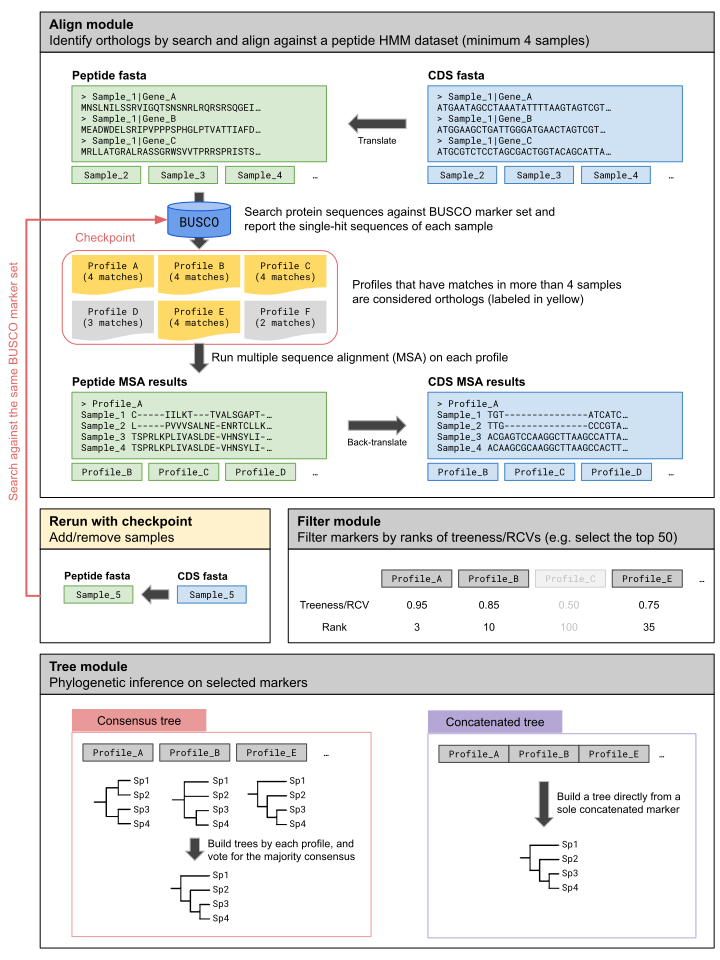
Phyling is a fast, scalable, and user-friendly software pipeline for phylogenomic reconstruction of species phylogenies directly from protein-encoded or nucleotide genomic data.
Published in G3: Genes|Genomes|Genetics: jkag062 (2026).
conda install bioconda::phylingpixi global install -c bioconda phylingFor alternative installation options (pip, Git clone, developer setup), see the Installation Guide.
cd example

# 1. Download HMM marker set
phyling download fungi_odb10

# 2. Identify orthologs and align
phyling align -I pep -o align -m fungi_odb10

# 3. Filter top 20 informative markers (via PhyKIT treeness/RCV)
phyling filter -I align -o filtered_align -n 20

# 4. Construct species tree (Consensus via ASTER/FastTree)
phyling tree -I filtered_align -o tree_out -fDetailed documentation, full CLI argument references, and technical deep-dives are available on Read the Docs:
- Installation Guide — Conda, Pixi, PyPI, and Developer Setup (
pyproject.toml). - Quick Start Guide — Complete tutorial on protein (
pep) and DNA (cds) inputs. - Command Modules:
- Download — Download & manage BUSCO HMM sets.
- Align — HMM search, CDS translation/back-translation, PyHMMER multithreading, and checkpoints.
- Filter — PhyKIT treeness/RCV (
toverr) ranking and marker selection. - Tree — Consensus (ASTER) vs Concatenation, partition analysis, and tree engines (FastTree, IQ-TREE, RAxML-NG).
- Pipeline Architecture & Benchmarks — Algorithmic design & scaling benchmarks.
- Nextflow Workflow — Scalable HPC (SLURM) & Cloud pipeline (nf_phyling).
- Citation & References — Publication metadata & BibTeX.
If you use Phyling in your research, please cite:
Phyling: Fast, scalable, and user-friendly phylogenomic reconstruction of species phylogenies. G3: Genes|Genomes|Genetics, Volume 16, Issue 5, 2026, jkag062. DOI: 10.1093/g3journal/jkag062